How to use a cost per wear calculator (with a worked example)
A step-by-step guide to the cost per wear calculator. Enter a price, guess your wears honestly, compare two items and read the result, with a real example.
The cost-per-wear idea is simple on paper: divide the price by how often you'll use something. In real life, two things get in the way. It's hard to guess how often you'll actually use a thing, and it's hard to compare two options when one is cheap and one is not.
So I built a free calculator that handles both. It's at favelist.app/tools/cost-per-wear, and it takes about a minute. Here's how to use it, with an example you can follow along with.
If you'd like the idea behind it first, start with the cost-per-wear rule. This note is the hands-on version.
What the calculator does
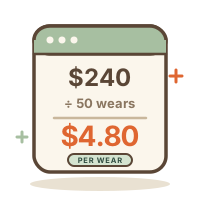
You put two items side by side. For each one you enter a name, a price, and how many times you expect to use it. For each, it shows:
- The cost per wear. Price divided by wears.
- A quick verdict. A short label so you don't have to judge the number on its own.
- A reality check. What your guess means in real life, like "about once every 3.5 weeks for a full year."
Then it compares the two, shows how the cost falls as you use the first item more, and gives you a link to share the result. There's no account, and nothing is saved. It all runs in your browser.
Step 1: Enter the price you'd really pay
Use what you'd actually pay: the sale price, plus shipping or tax if they apply. A "40% off" tag changes the price, not how often you'll use the thing, so the calculator only cares about the number you'd really hand over.
There's a currency picker too, so $, £ and € all work.
Step 2: Set your wears honestly
This is the step that matters most, and the one we all get wrong. A few ways to keep it honest:
- Think about this month, not someday. How often would you use it in the next four weeks? Multiply up from there.
- Count the season. A winter coat only gets a few months a year.
- Look at what you already own. If you have five black tops, a sixth will get fewer wears than you think.
- If you're unsure, cut your first guess in half.
The slider goes from 1 to 200 wears. The line under it translates your number into something you can picture, which is a good way to notice a guess that's too optimistic. Fifty wears sounds fine until it says "about once a week for a full year."
Step 3: Read the result
You get a cost per wear and a label to go with it:
- Under 2: Easy yes. Cheap per use. Hard to regret.
- 2 to 5: Good value. A solid price for something you'll use.
- 5 to 15: Needs a gut check. Maybe fine, but ask yourself again how often you'll really use it.
- 15 or more: Think twice. Expensive per use. It needs a good reason.
These are rough guides, not rules. The same cutoffs apply in every currency, and a special-occasion item can reasonably sit higher.
A worked example
Let's use the numbers the calculator opens with.
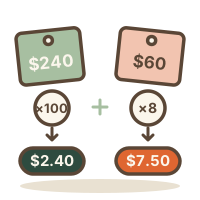
- Item A, a wool coat: $240, worn 50 times. That's $4.80 a wear, labelled Good value, about once a week for a full year.
- Item B, a trendy jacket: $60, worn 15 times. That's $4.00 a wear, also Good value, about once every 3.5 weeks.
The banner says the jacket wins, by $0.80 a wear. But it also says this only holds if you really wear each one that many times, and that part is worth testing. Move the sliders:
- If you'd wear the coat 100 times over a few winters, it drops to $2.40 a wear.
- If you realistically wear the jacket 8 times before you're tired of it, it climbs to $7.50 a wear, which lands in "Needs a gut check."
Now the coat wins by $5.10 a wear. Nothing about the prices changed. Only the wears did. That's the whole lesson: the number of times you use something moves the result far more than the price tag does.
Use the break-even bars
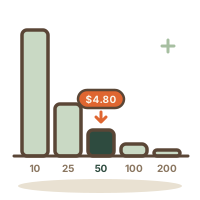
Under the comparison there's a small chart for Item A, with bars at 10, 25, 50, 100 and 200 wears. For the coat they read $24.00, $9.60, $4.80, $2.40 and $1.20.
It shows how quickly the cost falls, and where it stops falling much. The bar closest to your guess is highlighted. It's useful as a goal: if the coat is only $9.60 a wear at 25 wears, you know you need to keep wearing it. It also makes it easy to see when "just a few more wears" barely changes the number.
Share it and ask a friend
The Share this result button copies a link with your numbers in it. Anyone who opens it sees the same result and can change it. It's handy for the classic "is this worth it?" text to a friend. It only contains the item names, prices and wears you typed.
When cost per wear isn't the point
It's a tool for everyday things, not a rule for everything. A dress for a wedding you're excited about, a gift, or something that just makes you happy doesn't have to win on the math. I wrote more about that in the cost-per-wear rule.
Then give it a few days

Here's my favorite way to use it: run the numbers, then wait. If the math says yes but your gut says maybe, don't buy it that minute. Save it, give it a few days, and see whether you still want it. Your wear estimate gets more honest with a little distance. That's the idea behind the 30-day rule.
If you want more to think about, there are two more free tools next to this one: a work hours calculator that turns a price into hours of your own work, and a quiz to ask whether you should buy this. You'll find them all on the free tools page.
And if you'd like somewhere quiet to let things wait while you decide, that's what Favelist is for.

Sharon