The cost-per-wear rule: how to tell if something's worth it
A simple way to see what something really costs. Divide the price by how often you'll actually use it, and the "cheap" option often turns out to be the expensive one.
Price tags tell you what something costs today. They don't tell you what it costs to actually own it.
That's where the cost-per-wear rule comes in. It's one quick bit of math, and it changes how you look at almost everything you buy.
What is cost per wear?
Cost per wear is the price of something divided by the number of times you'll use it:
Price ÷ times you'll use it = cost per wear
It's called cost per wear because it started with clothes, but it works for almost anything: shoes, bags, a coffee machine, a desk chair. The idea is the same. Something you use all the time can be worth a higher price, and something you barely use is expensive no matter what it cost.
A quick example
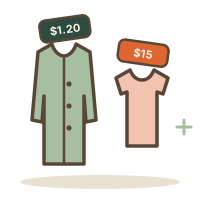
Say you're choosing between two things:
- A $120 coat you'll wear three times a week through the colder months. That's easily 100 wears this season alone. $120 ÷ 100 = $1.20 a wear.
- A $30 top that's fun but a bit "special." Realistically, you'll wear it twice. $30 ÷ 2 = $15 a wear.
The top looks like the cheaper choice. Per wear, it costs more than twelve times as much as the coat.
That doesn't mean the top is a bad buy. It just means the price tag was telling you only part of the story.
How to estimate it honestly
The math is easy. The hard part is guessing how often you'll really use something, because we're all a little optimistic when we're excited about a new thing.
A few ways to keep your guess realistic:
- Think about this month, not someday. How often would you use it in the next four weeks? Multiply from there.
- Count the season. A swimsuit or a winter coat only gets a few months a year.
- Look at what you already own. If you have five black tops, a sixth one will get fewer wears than you think.
- Cut your first guess in half. If you're honestly unsure, that's usually closer to the truth.
What it changes about sales
This is where cost per wear really earns its keep.
A sale makes something feel cheaper, but it doesn't change how often you'll use it. A $50 top at 40% off is $30. If you'll wear it twice, that's still $15 a wear. Meanwhile, a full-price $90 pair of sneakers you'll wear 150 times works out to $0.60 a wear.
So when you see a big discount, run the numbers before you get excited. "40% off" sounds great, but cost per wear tells you whether it's actually a good deal for you. It's a handy question to bring to your Black Friday list.
When cost per wear doesn't matter
It's a tool, not a rule for everything. Some things are worth buying even if you'll only use them once:
- A dress for a wedding you're excited about. One wear, and that's completely fine.
- Gifts. The point is the person, not the math.
- Things that simply make you happy. A beautiful candle or a book you'll love doesn't need to justify itself in wears.
Cost per wear is best for the everyday stuff, where it's easy to buy a lot of things that don't get used.
Waiting makes your guesses better
Here's the catch: when you first see something you love, it's hard to guess honestly how much you'll use it. Everything feels like it'll be worn all the time.
Give it a little time and your estimate gets much more accurate. After a week or a month, you'll know whether you're still picturing yourself wearing it every week, or whether the excitement has faded. That's the idea behind the 30-day rule, and it pairs perfectly with cost per wear. If you'd like a few more questions to ask, here are 8 to try before you buy anything.
The short version
- Cost per wear = price ÷ times you'll actually use it.
- The cheaper option isn't always cheaper to own.
- Guess your uses honestly, then cut that number in half if you're unsure.
- A sale lowers the price, not the number of times you'll use it.
- Some things are worth it at one wear. That's okay.
- Waiting before you buy makes your guess much more accurate.
And if you'd like somewhere quiet to let things wait while you figure out whether they're worth it, that's what Favelist is for.

Sharon